SANDY BEACHES – There are many varying beaches on Anglesey some such as Newborough Ligwy, and Aberffraw, which have a large expanses of sand and are important for intertidal flora and fauna. Sandy beaches offer sites for birds such as Oystercatchers, Ringed plover and Tern stones. There are many coves and smaller beaches, also important for wildlife. The decline on the beaches is mostly due to pollution from the dumping of waste, sea sewerage, broken fishing gear, accidental spillage of oil, ships’ rubbish and the recreational pressures of walkers and visitors, with ever increasing campsites and holiday homes being built near to beaches.
SAND DUNES – There are large scale dunes at Newborough and Aberffraw. Dunes are also at Rhosneigr, Valley, Tywyn Gwyn, Traeth Dulas and Red Wharf Bay and included within part of Beddmanarch – Cymyran SSSI. The planting of conifers at Newborough has resulted in the loss of open dune areas and their wildlife, lowering of the water table and cliffing of some areas. With the recreational input of car parks and footpaths has caused damage and pollution. Measures are in place to ensure protection and restoring sand dunes as functional systems. The area known as ‘Abermenai to Aberffraw Dunes’ which is a Special Area of Conservation (SAC). Aberffraw coastal marshes and dunes are areas where Small Eared Owls can be seen during the winter, it is a good hunting ground for them to hunt small animals such as Voles.
COASTAL SALINE LAGOONS -These are isolated salt water habitats, where specialised insects and plants can be found. Cemlyn Bay is a 25ha lagoon and is one of the largest and most important Welsh saline lagoons. It is thought that climate change is having an impact with the increasing severity of storms bringing a rise in salinity and pollution which can effect many of the species found there.
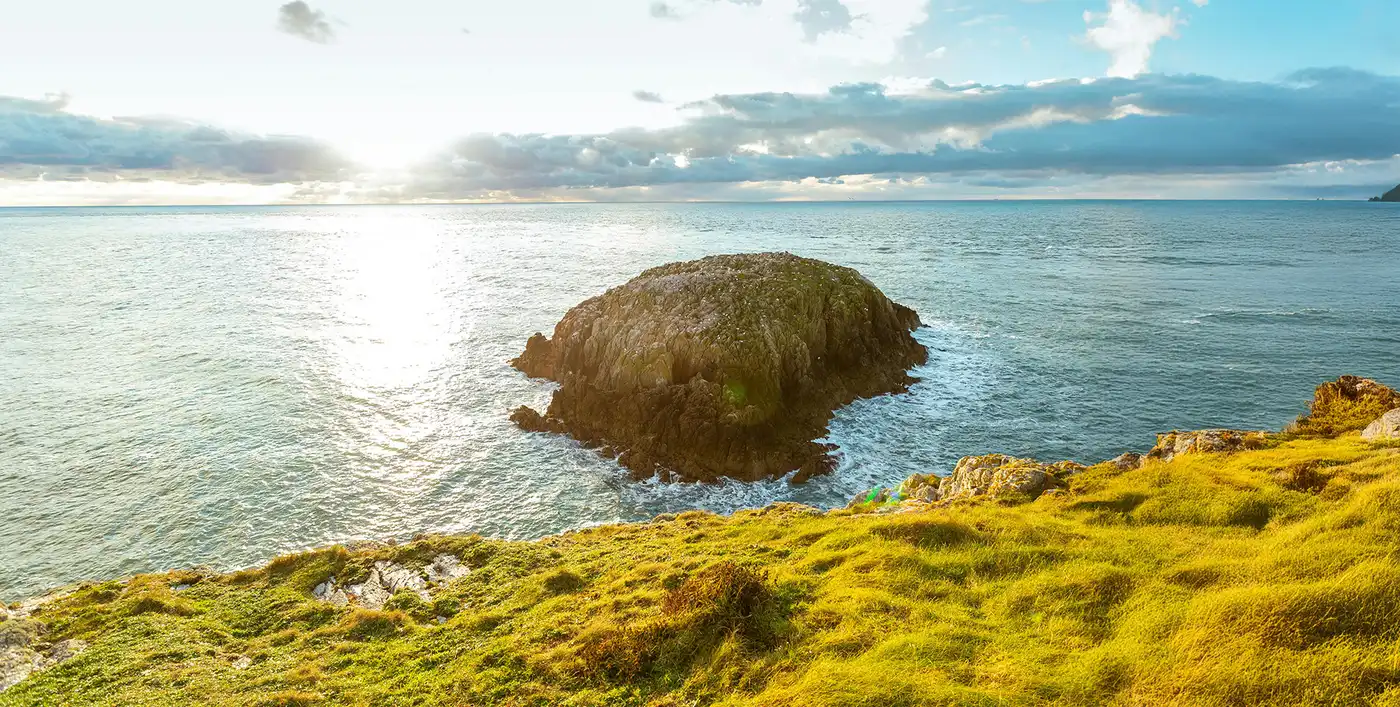
SEA CLIFFS AND ROCKY SHORES – These habitats are important for nesting seabirds and intertidal species. They are mostly found on the North west coast : Rhoscolyn, Trwyn Ifan, Ynys Llanddwyn; also Ynys Gybi. The RSPB reserve at South Stack is home to Puffins and other sea birds. Some areas are in decline due to recreational pressure e.g. footpaths, pollution from sewage, accidental oil spillage, and dumping of silage ,agricultural impacts to the cliff edge, and abandoning of traditional grazing. The National Trust owns some sections of the North coast : Carmel Head, Llanbadrig, Fedw Fawr, Clegir Mawr, Porth. Any future proposals for hydro electric projects will also be a concern.
MENAI STRAIT
The strait is of high ecological importance it separates the Island from the mainland of Wales, it is approximately 16 mi (25 km) long and varies in width from 400 metres (1,300 ft). The Strait connects to the Irish sea. It contains several islands, including Church Island (Ynys Tysilio), on which is located St Tysilio’s Church.
There are over 1,400 recorded species of plants and animals, in this habitat and the area is designated as a Special Area of Conservation (SAC). This habitat contains benthos organisms living in and include micro-organisms (e.g., bacteria and fungi), as well as larger invertebrates, such as crustaceans and polychaetes. This habitat is home to over 50 species of sponges which help as filters to remove harmful particles and maintain water quality providing a diverse range of marine life. Penmon Point at the northern end of the Menai Strait plankton can be found providing a light show in June and July. The Menai Strait supports a diversity of bird species, protected sea horses, and lobsters.
RIVERS AND STREAMS – Provide habitat for Otters and Water voles and act as corridors for many species. The total area of rivers and streams is about 372km and 26km is classed as tidal main rivers and another 32km make up the Menai Straits . Afon Ffraw is protected within the Tywyn Aberffraw SSSI. Part of Afon Cefni lies within Malltraeth Marsh SSSI. All rivers except lower Afon Cefni and Afon Goch, are of high water quality (EA). condition.
Afon Seiont is a river in Gwyneddd which runs into the Menai Strait changing it’s name at several locaions, as rivers drain the northern slopes of Snowdon and forms a natural hsrbour as it drains into the strait at Caernafon.
During the 1950’s-60’s most of Anglesey’s rivers were deepened and straightened which has caused the removal of bankside vegetation, lack of floodplain function and dead wood channels. Grazing and pollution has also degraded water and bank sides.
PONDS – Anglesey has many ponds mostly in fields within farmland. They are important freshwater habitats for amphibians, dragonflies and other invertebrates, water plants and birds. Some farmers have restored old ponds but they are often stocked for fisheries. The natural ponds have been in decline due to natural succession/sedimentation and lack of cleaning.
GRAZING MARSH AND WETLAND FENS- Anglesey has a large expanse of fens three of which are National Nature Reserves (NNR’s) : Cors Erddreiniog (the largest of the three), Cors Bodeilio and Cors Goch. It is the alkaline water draining into these wetlands on Anglesey that creates the unique conditions that support an unusual combination of plants, many of which can only exist in this type of alkaline habitat. The plants in turn harbour many species of insects, which have become rare elsewhere in the UK. The mix of wet pasture in these habitats are important feeding and breeding areas for birds including Curlew, Llapwing and Snipe, the ditches support water plants and invertebrate communities. Water voles and Otters use rivers, drainage channels and associated habitats. This habitat covers 3200ha, of which Malltraeth Marsh is an SSSI . Floodplain and grazing marsh have suffered due to the changes in the sward from agricultural improvement, increased livestock leading to the trampling of birds nests, intensive drainage by machinery reducing water levels, nutrient enrichment of watercourses and the spreading of agricultural waste.
LOWLAND AND COASTAL HEATH – These habitats are covered by shrub, bracken, heather, grassland, mire and bare ground which can be dry or wet. These areas are important habitats for flora and fauna such as Marsh Gentian. Lowland and coastal heath has been affected by overgrazing, recreational use, and encroachment of the land . There are some restorations taking place by;- Wales Coastal and Lowland Heathland Strategy . Anglesey Heathland Strategy HLF project, Management of Mynydd Twr (RSPB), Cors Goch, and Mariandyrus. (NWWT), Cors Erddreiniog and other SSSIs (CCW), Bryn Offa, Fedw Fawr (NT) and Existing ESA agreements.
FARMLAND/GRAZING – Farming is the dominant source of income for Anglesey and farmers are the custodians of the land creating the scenic backdrop for the tourism industry. The land is mostly grassland pasture with sheep and cattle grazing, only a small proportion of holdings are dedicated to crops. Source:https://senedd.wales There is a general renewed interest in Wales for improving conservation practices in farming with the organisations Nature friendly farming and https://www.nffn.org.k and the Esemee Fairbairn Foundation hhtps://esmeefairbairn.org.uk being two organisations working and supporting farmers to achieve sustainable nature friendly conservation practices for wildlife and their land. One project by Esmee Fairbairn is Blue Spaces – Wales, which is supporting projects looking after freshwater habitats.
MEADOWS – Healthy meadows are thriving ecosystems, they are home to wildflowers, including those that are threatened with extinction, such as the green-winged orchid. They are essential for pollinators and provide the life support for our invertebrates, birds and mammals. Meadows are carbon sinks and they hold back water providing a flood defence, they also lock up pollutants and help to reduce negative impacts to air, water and soils, and ultimately the food chain.‘’Wales occupies 8.6% of the total UK land area but hosts 40% of the UK’s semi-natural grasslands. Yet these grasslands are being lost, as a result of agricultural improved, meaning that grasslands have been ploughed and sown with simple mixtures of just rye grass and clover and applied with synthetic fertiliser. In parallel, Wales has experienced declines in insect and bird life – 60% of Welsh butterflies are in long term decline; seven species of Welsh bees are known to have gone extinct since 1850, and five more are at risk of extinction in the next twenty years.’’ Source: www.plantlife.org.uk.
WOODLAND
Most of Anglesey’s woodland has been felled historically, the total area of broadleaf woodland and scrub left is 3149ha, or 4.4% which compares to the Welsh figure of 15%. Most of the broad leafed semi-natural woodland on the Island is located in the south along the Menai Strait, Cadnant Dingle SSSI, Dingle LNR, Coed Cyrnol, Plas Nwqydd and a small wood at Penrhos near Holyhead, these areas are home to native trees, such as alder, ash, silver birch, elm, oak and rowan, as well as shrubs such as blackthorn and hazel. The Ash and Sessile Oak are the most common and the semi-natural species Sycamore is was introduced and is now abundant. Broadleaved woodlands are important for the red squirrel and for flora such as the bluebell. Much of the woodland is in decline due to fragmentation, un-controlled grazing, invasive species and neglect.
HEDGEROWS – Anglesey has lost a lot of its ancient hedgerows due to removal to make large fields and road widening. The stripping of bank vegetation has also led to erosion and a rise in nutrients which can effect plant communities. Hedgerows are important for wildlife they link corridors for both fauna and flora and provide habitat for many species, for example hedgerow’s can be a hot spots for bats for their insect hunting grounds. Adding varying degrees of height and depth from different plants and tree species creating structural diversity will increase wildlife species biodiversity. Species diversity will increase differing timings of flowering and different food sources, therefore increasing fauna diversity. The interconnection that then results from this has a control aspect for farms. There is some protection now for hedgerows due to the Hedgerows Regulations (1997).