Anglesey has a rich diversity of wildlife, with sea birds in large numbers and seahorses off the Meni coast. The wooded areas although fragmented contain Red Squirrel, there have been some Grey squirrels found on the Island which are managed. Although diversity is key, there are some species that are in decline and under threat,( not all species are mentioned here).
ADDER (Vipera berus) IUCN Red list conservation status, listed of least concern, and declining in numbers. Adders are found on many of Anglesey’s nature reserves and protected under UK law. Rare black adders have been sighted on Anglesey. “Adders are Britain’s only venomous snakes, but they are very unlikely to kill you. The adder lives in thick vegetation they use this to hide from predators and hibernate, some adders may use the same hibernaculum for life. These areas are vital for the survival of the species.’’ Their threats include humans, ‘’adders are still persecuted by humans, with many still killed each year due to fear or ignorance. Habitat loss and increased pesticide use has also put pressure on this species and the food it eats.’’ Source; www.kentwildlifetrust.org.uk/blog/ultimate-guide-adders.
BADGER (Meles meles), IUCN Red list conservation status, listed of least concern. This classification is not up to date and does not account for the loss of UK badgers due to the last few years of culling licence in England, (In Wales they are trapped and vaccinated against TB). Badgers have protected species classification. British Badgers prefer deciduous woods with clearings, or open pastureland with small patches of woodland, also found in mixed and coniferous woodland, scrub, suburban areas and urban parks. The badger has an omnivorous diet, including fruit, nuts, bulbs, tubers, acorns, and cereal crops. It also consumes a variety of invertebrates. Badgers hibernate during winter. Threats include; human predation, pollution, loss of habitat, there are few habitats available on Anglesey.
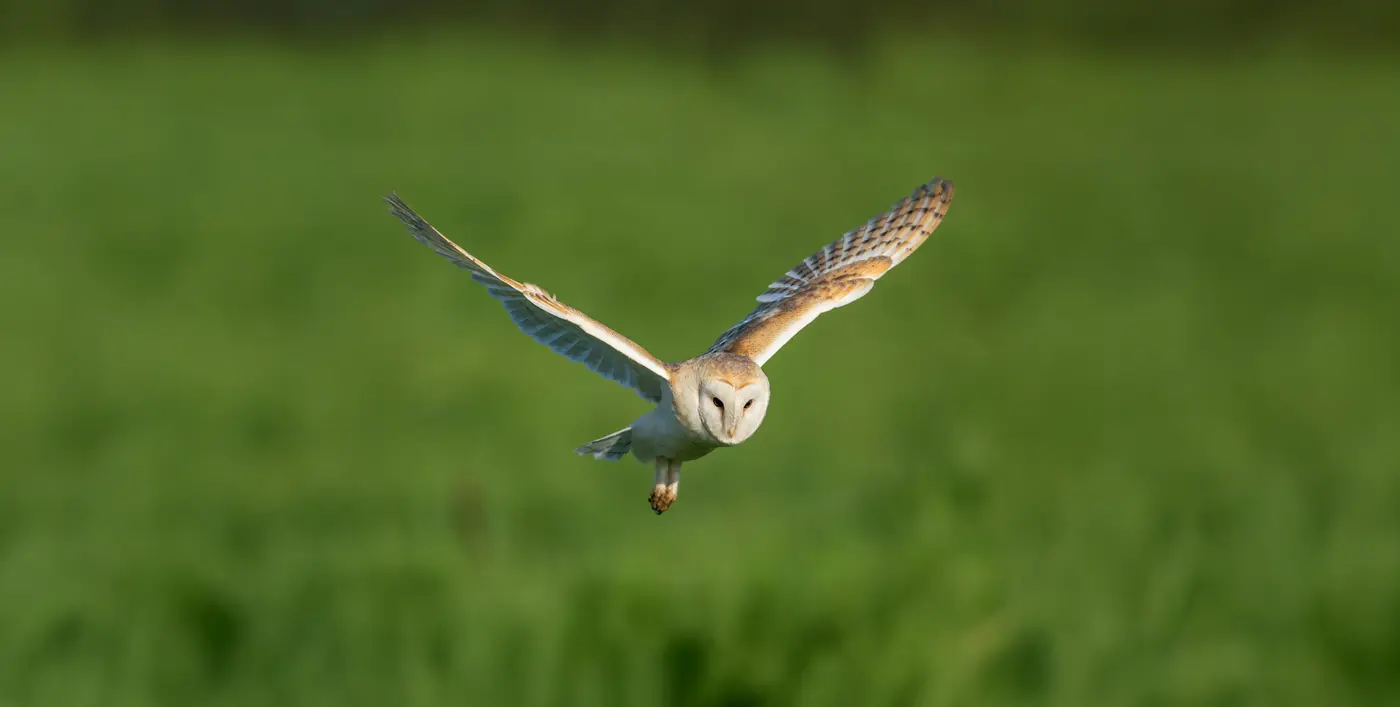
BARN OWL (Tayto alb) IUCN Red list conservation status, listed as least concern. Protected in the UK under the Wildlife and Countryside Act, 1981. They can be found on Anglesey in areas where farmers and landowners manage grassland edges, drains and field boundaries to benefit the field vole and other prey. They will hunt at dusk alongside ditches and roads. Threats include traffic as the owl swoops low and eating rodents which have been poisoned, intense farming and less field margins. Source:www.barnowltrust.org.uk
BASKING SHARKS
The largest shark species around U.K. waters, they can be seen off the coast of Anglesey during warmer months May – September. They filter feed on zooplankton close to the surface of the water.
BATS
PIPISTRELLE BAT Commom ( Pipistrellus pipistrellus ) IUCN Red list conservation status, listed as stable. The smallest Brittish bat: Length 4 cm, Wingspan about 22 cm. Soprano pipistrelle (Pipitrellus pygmaes). Current Status: IUCN Red list conservation status, listed as widespread. Further survey’s are needed to determine where each is present and their population numbers. They are under threat due to loss of roost sites, mostly due to building renovation, and through use of toxic timber preservatives. There is also a decline of feeding areas and insects due to the decline of wetlands, hedgerows and woodlands. Gwynedd bat group are monitoring some colonies.
HORSE SHOE BAT
Greater Horseshoe Bat (Rhinolophus ferrumequinum )IUCN, Red list conservation status is listed nearly threatened globally. In Wales, Greater Horseshoe Bats breed at the northern limit of their distribution. Bat roosts are within Special Areas of Conservation, where they can be monitored. The greater horseshoe bat primarily roosts in old buildings and prefers habitats with a mix of pasture, woodland edges, and hedgerows, where it can find its preferred prey of midges, moths, and other flying insects.
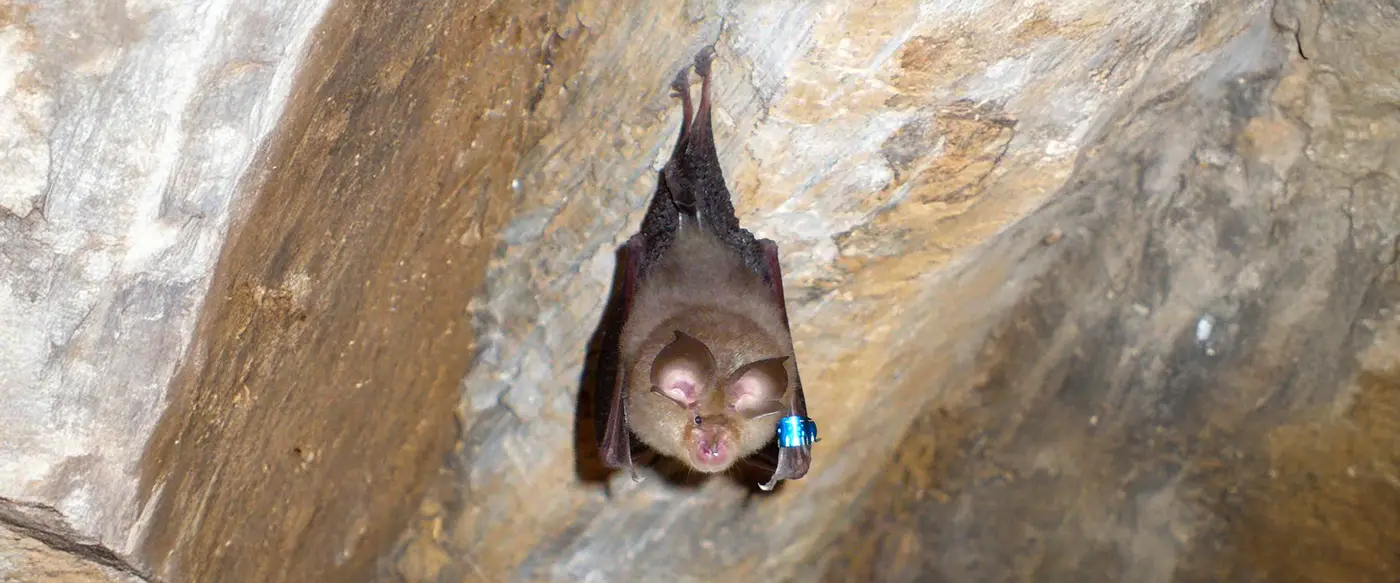
Lesser Horseshoe Bat ( Rhinolophus hipposideros). IUCN Red list Conservation status is listed as common. They are the smaller species and breed up to the north coast of Wales where they are fairly common. They feed on flies, mosquitoes, butterflies moths and spiders , they roost in colonies in old buildings, and hibernate in caves, mines and cellars.
THE BROWN LONG EARED BAT (Plecotus auritus) IUCN Conservation status is of least concern. They have distinctive long ears of between3.3-3.9 cm length with a fold, they have a body length of 4.5-4.8cm . They have large eyes and they can hunt by hearing and visualisation. They are slow flyers, feeding on mostly moths, flies and insects , roosting in buildings, caves and trees. The brown long eared bat has priority species status under the U.K. post 2010 Biodiversity framework
Threats to all bats include changing farming practices, development with disruption to roosts, fragmentation of habitat, pesticides, reduced insect prey, preditors like cats, owls and birds of prey..
All bat species are protected under the Wildlife and Countryside Act 1981.and have provisions for protection under the Planning and Infrastructure Act 2025. Source; bats conservation trust. https://bats.org.uk
BITTERN (Botaurus stellaris) IUCN Red list conservation status, listed as decreasing. Protected under Wildlife and Countryside Act, they are usually only seen whilst hunting prey along reedbed edges . Populations have declined due to reduced wetland habitat, poor water quality and declining fish populations and fragmentation of reedbeds. There has been a restoration project by the RSPB and establishment of reedbed reserves at Malltraeth Marsh and Valley Wetlands.
CHOUGH ( Pyrrhocorax pyrrhocorax) IUCN Red list conservation status, listed as decreasing. A distinctive crow with red beak and red legs. Feeds on ground on insects in low-intensity coastal farmland areas. Dependent on grazing for supply of dung invertebrates. Protected under Wildlife and Countryside Act. Found mainly on Anglesey which is one of their strongholds. They can be found year round on the North West coast of Anglesey (such as Wylfa), South Stack area, also Penmon. Threats include lack of quality of foraging habitat, human disturbance e.g. climbing, walking and bird-watching. Egg collecting, and shooting, natural predators such as peregrine may affect roosts and fledging success. Current Action: Habitat management at South Stack by the RSPB, surveys and Chough Habitat Restoration Project. Cross and Stratford Colour Ringing Project (CSCRP). Choughs are a member of the crow family, they are only found on the extreme Western and rocky coasts of the UK.
COMMON TOAD (Bufo bufo) IUCN Red list conservation status 2012, is listed as least concern but decreasing in population numbers. Although protected by law only from sale and trade, they are a biodiversity priority species under the Natural Environment and Rural Communities (NERC) Act (2006) because of recent declines. This means that the species should be considered during planning and development. It becomes active at bight hunting invertebrates. Juveniles emerge from breeding ponds and remain terrestrial, in forested areas, fields, copses and gardens. Threats include loss of habitats and breeding ponds, road kill during migratory times, predetors include, snakes, hedgehogs, rats, cats, birds of prey.
DOLPHINA – Anglesey Dolphins – there are two main species that regularly visit the islands coast. These are the Bottlenose Dolphin and Harbour Porpoise.
BOTTLE NOSE DOLPHIN,( Tursiops truncatus) IUCN Red list conservation status, listed as least concern. They are intelligent and curious. Dolphins grow up to around 4 metres in length and are identifiable by a sickle shaped dorsal fin. The UK biggest pod of these dolphins lives to the South of Anglesey in Cardigan Bay.
HARBOUR PORPOISE( Phocoena phocoena). IUCN Red list conservation status, listed as decreasing. Small members of dolphin family, which has declined in recent years. Protected under Wildlife and Countryside Act. There is a lack of data for exact numbers in Anglesey waters, it is thought there may be several groups. Harbour Porpoise stay closer to the shore and can be seen in harbours and estuaries. They are small up to 1.5 metres in length.
Threats include pollution e.g. plastic bags, abandoned fishing gear, mercury, disturbance by speed boats and jet skis, fishing techniques (the species can be a by catch), and shipping lanes.
CRAYFISH / SPINY LOBSTER
Freshwater Crayfish (Austropotamobius pallipes) IUCN Red list conservation status, is listed as Endangered 2010. This is the U.K.’s only native freshwater crayfish. They are listed in the UK Biodiversity Action Plan as a threatened species. Once common around the coast of Anglesey is now declined by 90%, mostly due to over fishing and the competition from the invasive Signal crayfish, and pollutants from agriculture, water crafts. It is an important indicator of good quality water a Seiont research project is working on the reproduction larval cycle for farming spiny lobsters. Anglesey sea zoo is part of a captive breeding programme.
Signal Crayfish (Austropotamobius pallipes) ) IUCN Red list conservation status, is listed as least concern. They are larger and more aggressive than the native Freshwater crayfish and outcompete for food and shelter, they also carry crayfish plaque which is a fungal disease and is 100% fatal to the native species. They are know to cause habitat distribution when they burrow into riverbanks. Their diet is fish eggs, tadpoles, and invertebrates.
GRASS SNAKE (Natrix helvetica. ) IUCN Red list conservation status, listed as least concern, 2024. It is Britains largest and harmless snake, it favours wetlands and gardens with ponds, sand dunes with Marram grass. They are seen between April to September, they have a grey green body with a black and orange/yellow collar and they grow up to a metre long. The feed on eggs, small mammals , lizards, frogs and spiders. Source www.angleseyisle.co.uk
GREAT CRESTED NEWT (Triturus cristatus). IUCN Red list conservation status, listed as decreasing. Protected under Wildlife and Countryside Act. This is the largest of the British Newt, with two species on Anglesy The island is a Welsh stronghold of the species. As with other amphibians, the Menai Straits effectively isolate populations from the mainland. Present at Glantraeth SSSI (Newborough) and at Cors Erddreiniog, Salbri, Cors Clegyrog, Cors Goch, Valley and Newborough Forest . Threats include the lack of habitats and food, infilling of field ponds and development, pollution, poor genetic population numbers, small isolated populations.
HARE ( Lepus timidus) IUCN Red list conservation status, is listed as , Globally of Least concern 2019 and stable. Threats include, predation, climate change, intensive farming pollution and hunting all are adding to their decline in localised areas.
WESTERN EUROPEAN HEDGEHOG (Erinaceus europaeus ) IUCN Red list conservation status, is listed as Near threatened 2023and decreasing in population numbers. Their habitat is forested areas and grassland, gardens, parks. Hibernating in the winter under leaflitter and grass and fallen logs in hedgerows, under garden sheds and man made hog houses. They feed on Feeding on invertebrates, eggs, carrion and some plant material.
Threats include habitat fragmentation and a decrease in natural invertebrate prey, road kill, preditors, human intrusion, domestic waste, poisons, agricultural and forestry effluents. National Hedgehog Monitoring Programme,(NHMP) launched 2024 by PTES and BHPS, in partnership with Nottingham Trent University, Zoological Society of London (ZSL) Mammal Web, London HogWatch and The University of Durham, which will provide invaluable data on population numbers, locations and changes at a local and national level.
Source ; The British Hedgehog preservation society www.britishhedghogs.org.uk
OTTER (Lutra lutra.) IUCN Red list conservation status, is listed as near threatened and depleted 2021. Otters are found in a variety of habitats; rivers, lakes, seashore etc. Protected under Wildlife and Countryside Act, they have been re- established on Anglesey. Threats include;- pesticide and sewage, slurry, lime run off from fields, riverside habitat loss, overgrazing leading to loss of bankside vegetation, poor water quality, human interference and traffic . Current action includes Anglesey Otter Project with Menter Môn and EA., the overall objectives and targets are to ensure stable populations in the long term.
PINE MARTIN (Martes martes ) IUCN Red list conservation status, listed least concern and stable. Habitats are forested areas and scrub . ‘’Their diet consist of voles, mice, squirrels, rabbits, birds, and amphibians. Carrion is a major food source in the winter. Bees’ nests, mushrooms, and berries are also sometimes eaten. It is solitary, but not highly territorial. The home ranges often overlap partly or even totally.’’ Source www.iucnredlist.org
Humans are a large threat due to human disturbance, hunting, poisoning, road kill. They are offered full protection under the Wildlife and Countryside Act 1981 and Environmental protection Act 1990.
The reintroduction of the Pine Martin into North Wales has been credited for the management of the invasive Grey Squirrel to sustain population numbers of the native Red squirrel as the Grey squirrel spends more time on the ground than the red squirrel and they are slower and more easily predated upon than the Red Squirrel. ‘’Confirmed sightings of Pine Martins on Anglesey in 2022 in over 30 years has given hope for conservation efforts in the region’’ Source; www.bangor.ac.uk
PETALWORT (Petalophyllum ralfsii ) IUCN Red list conservation status, listed as decreasing. A rare species in the UK, known from less than 30 sites. the largest known UK populations are on Anglesey. Included in the Wildlife and Countryside Act (Schedule 8). A light green liverwort up to one cm in width, and looking like a tiny lettuce. Grows on areas with damp open sand, where competition from higher plants is low. Widespread at Newborough and Aberffraw dunes in wet dune slacks. Threats include drying of dune slacks due to afforestation. – Lack of grazing at Aberffraw may be having adverse effects, colonisation by other plants, over disturbance.
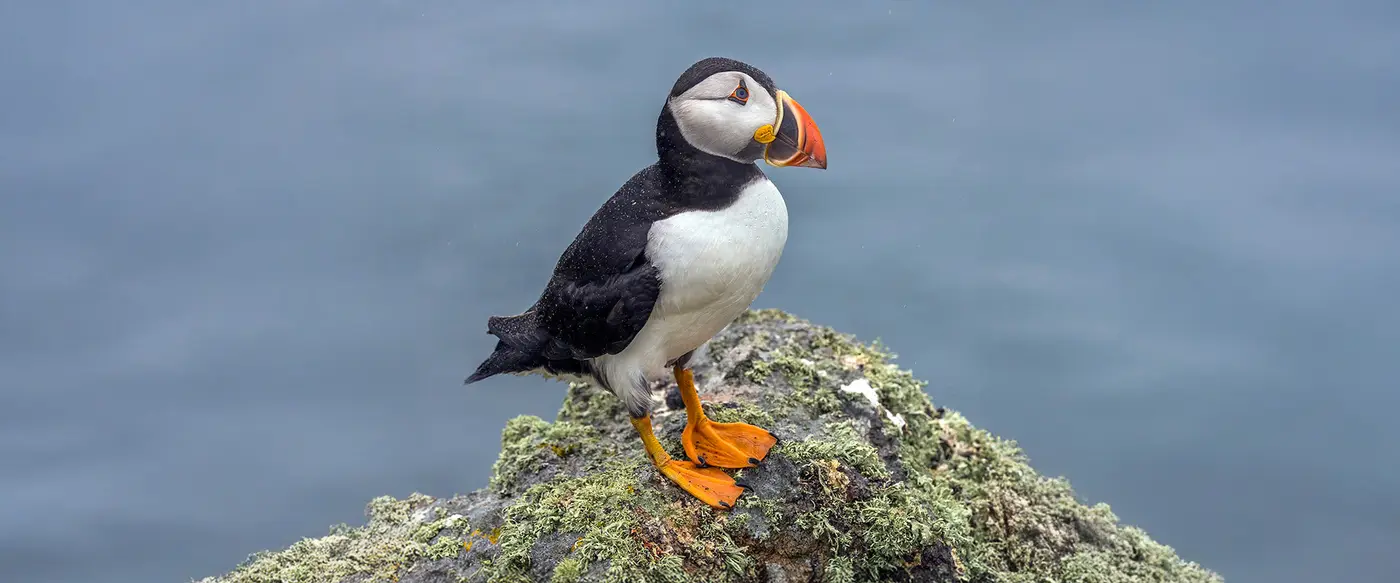
Puffin (Fratercula arctica) IUCN Red list conservation status, is listed as vulnerable and decreasing. With half of the UK population at only a few sites, on Anglesey they are found at South stack, managed by the RSPB and Puffin Island Ynys Seiriol located at the North East entrance of the Menai Straits and is the ninth largest island off the Welsh coast . 69 acres (0.28 km2). The island is privately owned by the Baron Hill estate. Puffin Island is a Special Protection Area (SPA) and is also home to great cormorants, guillemots, razorbills, shags, kittiwakes, herring gulls and both lesser and great black-throated gulls. there are still only 8 breeding pairs of puffins on the island. The Puffin breeding season is from April to July ,they head back to land for the breeding season, and dig burrows to lay their eggs. Puffins are decreasing in numbers mostly due to a reduction in their main food source Sand eels which in turn are disappearing due to dramatic changes in their plankton diet, there is simply not enough food for Puffins to feed their young.
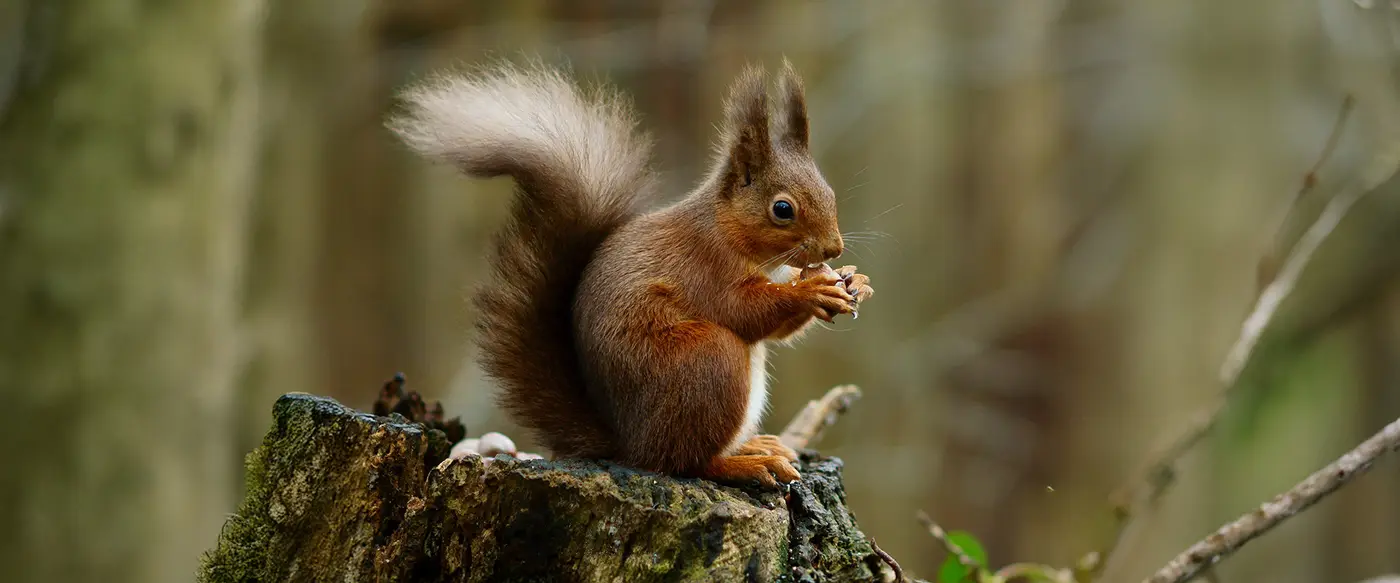
RED SQUIRREL (Sciurus vulgaris). IUCN Red list conservation status, listed global 2016; is decreasing. This native species is under threat from competition with the non native North American Grey squirrel and the Parapox virus which this species can carry.
The fragmentation and destruction of habitat is a threat to surviving populations. Anglesey Red Squirrel project: Includes grey squirrel control campaign and community group Friends of the Anglesey Red Squirrels aim to establish sustainable populations. The Red Squirrel programme has been running since Anglesey re-introduced the species following their decline in the 1980’s and populations of Red Squirrel have doubled since 2000 and exist at Pentreath forest, Newborough forest, Dingle, Penhros, Plas Newydd and recently seen in Cemaes Valley. The Red Squirrel Project which, funded and managed by Menter Môn (the Anglesey Enterprise Board), seems to have been very successful. Research in 2007 in the UK credits the Pine Martin with reducing the populations of the invasive Grey squirrel.
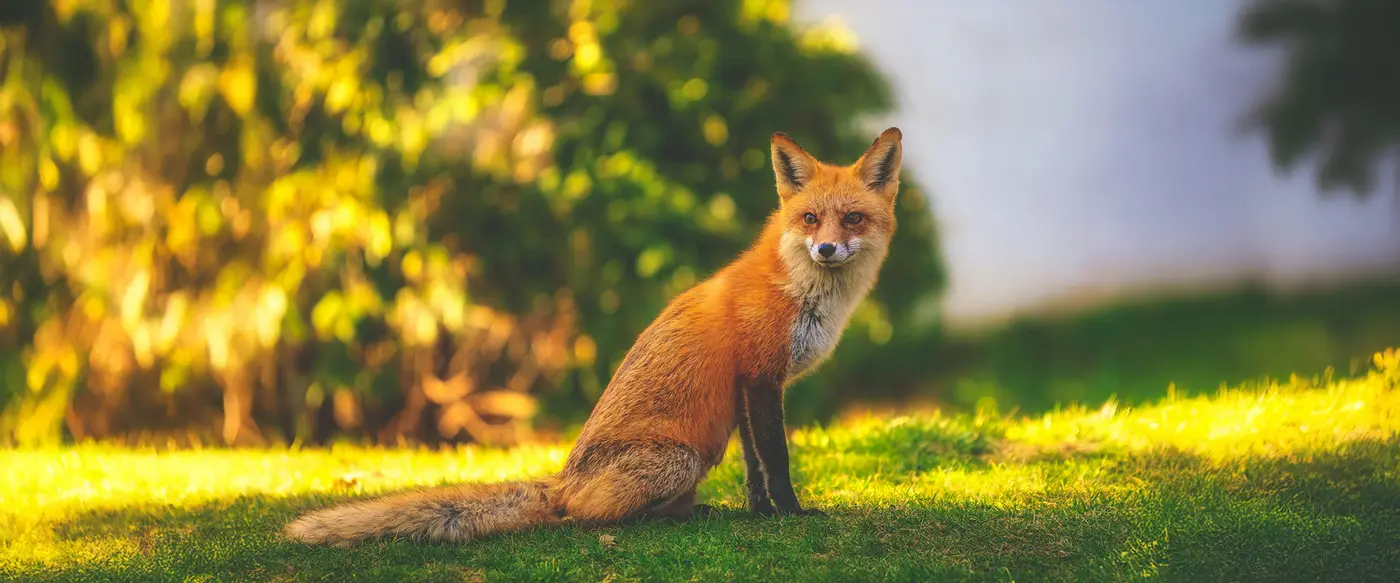
RED FOX (Vulpes vulpes) , IUCN Red list conservation status, listed global is least threatened, however they are continuing to decline in the UK farming areas, due to poor quality habitat and human, animal conflict. Their natural habitat is a dry mixed landscape with abundant scrub and woodland, with natural habitat loss they are now flourishing in urban areas. Threats to this species are highly localised and include habitat degradation, loss, and fragmentation, and exploitation, and direct and indirect persecution. They are perceived as pests to farmers as they predate on eggs and fowl, they are demonised and used for hunting.
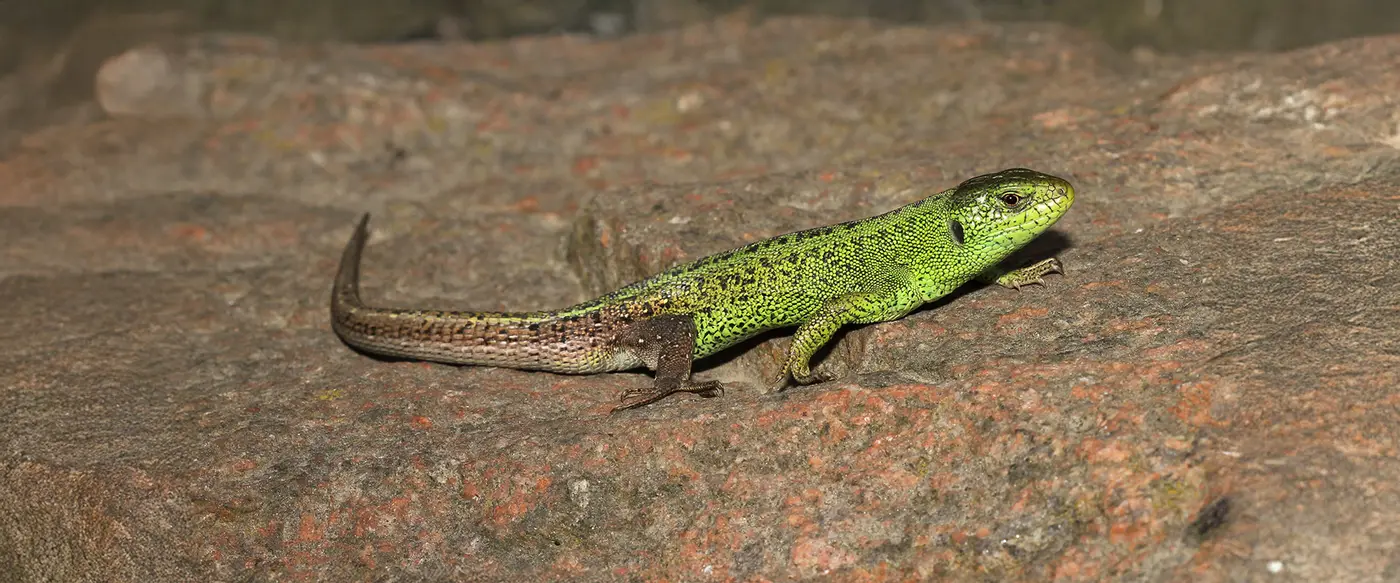
SAND LIZARD (Lacerta agilis), IUCN Red list conservation status, listed as extremely rare around the UK due to the destruction of their natural habitats. As their name suggests they live in sandy dunes and heathland in coastal areas and now naturally confined to only a handful of places, reintroduction programs have begun to try and increase numbers. This makes them the rarest Anglesey lizards. Their diet consists of small invertebrates like beetles and worms, supplementing diet with flower heads and fruits.
Threats include. Recreational tourist pressures, fires, predators such as birds of prey, foxes, weasels. Housing and agricultural development, changes in land use, pollution.
‘’A series of surveys run as part of the NRW’s sand of life project found sand lizard population across 10 separate survey visits at the two surveyed sizes Aberffraw and Newbourough ’’ source; Natural resources Wales.
SEA HORSE;
Long-snouted sea horse (Hippocampus guttulatus), IUCN Red list conservation status, is listed as Data deficient 2016.
Native to Britain, the Long snouted sea horse is found around the coast of Anglesey. Threats include, habitat loss (Sea grass), pollution, fishing, boats (Anchor’s) jet ski’s, motor boats domestic and urban waste water, agriculture and forestry effluents, changes in climate of water warming .
Anglesey Sea Zoo have successfully bred the short snouted sea horse. It is now illegal to kill, take or disturb seahorses in British waters, their habitat seagrass meadows and seagrass beds are also protected.
SHORE DOCK (Rumex rupestris) IUCN Red list conservation status, is listed as vulnerable and decreasing. Protected under Conservation (Natural Habitats etc) Regulations 1994 and Wildlife and Countryside Act. A member of the dock family which is now very rare. Found in dune slack areas within plantation at Newborough Forest. Population is expanding, but is isolated.
SONG THRUSH (Turdus philomelos) IUCN Red list conservation status, is listed as of least concern, stable. Protected under Wildlife and Countryside Act. A popular songbird which has declined in some areas, likely to be due to changes in agriculture. Threats due to pesticides, hedge cutting in autumn removing food sources , autumn sowing, loss of habitat such as hedgerows and cat predation and birds of prey.
Yellowhammer(Emberiza citrinella) IUCN Red list conservation status least concern, decreasing. A partially migratory bird. They nest at forest edges and large clearings, it has benefited from traditional agriculture, which created extensive open areas with hedges and clumps of trees. There were some seen at Cors Goch Nature reserve, however due to changes in farming practices they are seldom seen now. They are predated on by rodents, cats and birds of prey.
Grey Partridge (Perdix perdix) IUCN Red list conservation status, least concern, decreasing. It is a farmland bird which flys low, breeds in open scrub close to hedges. They are under threat due to intense farming and shooting.
Corncrake (Crex crex) IUCN Red list conservation status, is listed as of least concern, however this is due to the large number recorded in Russia and China. It is a migratory bird found ground nesting mostly in hay fields, it is often mistaken as a game bird. Predated on by cats, and birds of prey. They are in decline in the breeding season due to farming practices of mowing hay too soon, ‘’ killing 38–95% of chicks in a given site, and losses average 50% of first brood chicks and somewhat less than 40% of second brood chicks, chick growth is faster in dry or warm weather’’, therefore climate change may now be impacting survival rates.
Source, wikapedia
Tree Sparrow (Passer montanus) IUCN Red list conservation status, is listed least concern, decreasing. The tree sparrow has declined, ‘’thought to be by 93% between 1970 and 2008. In areas where they’re clinging on, they’re usually associated with farmland. They form small colonies in the breeding season, and then come together into larger flocks in the winter to feed in stubble fields, often mixed in with other species. Tree Sparrows will nest anywhere with a suitable hole or crevice. ‘’ Threats include a less available food source of insects and seeds, predation by cats and birds of prey.
source RSPB. , Game and wildlife trust.
WATER VOLE (Arvicola terrestris) IUCN Red list conservation status, listed as of least concern, stable. Protected under Wildlife and Countryside Act. A semi-aquatic burrowing rodent found at the side of rivers and streams and ditches. The population fell in many areas in 80s and 90s, as they were predated on by mink. Anglesey is likely to be a stronghold for water voles, especially wetlands in the south and east of the island. They are threatened by habitat fragmentation, poor water quality, maintenance of wider river habitats and wetland sites, overgrazing and flood management. Anglesey is a key water vole monitoring site for the UK BAP water vole group. Monitoring island for mink, with trapping on mainland in Menai area and Snowdonia. EA, CCW. Anglesey Water Vole Project, from 2001.